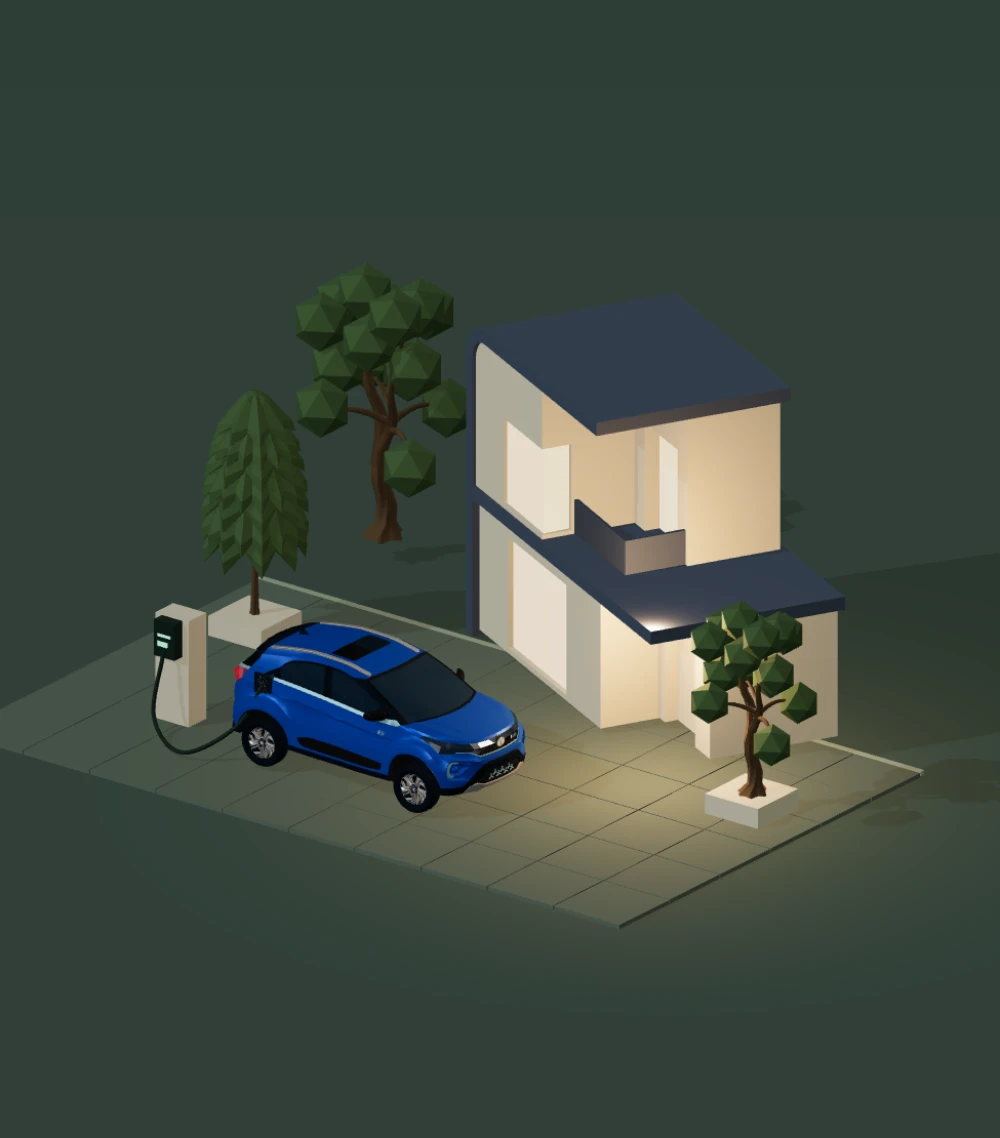
How long your car takes on a socket or a wallbox, what it costs at your rate, and what to sort out before the first night. Then the app keeps every home charge for you.
How long it takes depends on two chargers.
One is on your wall. The other is inside the car, and it sets the ceiling: a home charger can only go as fast as the car accepts on AC. Pick your car to see where that ceiling is.
38.5 kWh usable · takes up to 7.2 kW on AC
Your Nexon.ev can use the full 7.2 kW of a larger wallbox. From 20% to 80%, that’s 3 hr 30 min instead of 11 hr 5 min on a socket.
Steady power the whole way; real charging slows a little near full. Battery and AC limit from the Nexon.ev page in our catalogue.
What it costs is on your electricity bill.
Home charging is billed by your electricity company, at your home’s rate per unit. One unit is one kWh. Put in the rate from your bill and see what this charge costs.
₹per unit
₹8 is an example. Your bill has your rate.
20% → 80% on a 3.3 kw wallbox₹203
You’ll pay for about 25.4 units. About 23.1 kWh of that ends up in the battery.
From your meter
25.4 units
Into the battery
23.1 kWh
Time
7 hr 40 min
Per 100 km in the city
₹110
Per 100 km uses the Nexon.ev’s city figure in our catalogue, 125 Wh/km. Your driving will differ.
What if your rate changes by the hour?Some electricity companies charge more at some hours and less at others. The app uses one rate today; try yours here.
₹
₹
₹
Ready by 5:40 AM the next day, for ₹254 (more than ₹203 at one rate of ₹8).
The rates here are examples, not any company’s tariff. Ask yours whether it has time-of-day rates where you live.
Set it up once. Plug in knowing.
Add the place and the charger in the app once: at home, at work or in your society. After that, every charge starts with the time and the cost in front of you, and ends up in your charging history.
9:41▮▮▮
Search Location
Set your addressDrag map to move pinLocation typeHomeWorkOthersPinned locationThe address under the map pinParking typeINDOOROUTDOORConnection typeSingle phase ▾
Screens from the Chargespot app, recreated. The place, charger and rate follow your choices on this page.
Before the first night, four things to sort out.
Most of this is a one-time job. None of it needs us: it’s between you, an electrician and your electricity company.
1
Start with the charger in the box.
Many EVs come with a portable charger that plugs into a regular power socket. Check what came with yours before buying anything.
2
Have an electrician check the circuit.
A dedicated socket on its own circuit, with proper earthing and a residual-current breaker. Never charge through an extension cord or a multi-plug.
3
Decide whether you need a wallbox.
Use the times above. If a socket fills your car overnight for the way you drive, it may be enough. A wallbox faster than your car’s AC limit won’t charge it faster.
4
Talk to your electricity company.
Ask whether your sanctioned load covers a charger, and whether there’s an EV tariff or a separate EV connection where you live. The rules differ from state to state.
No driveway of your own? Charge where you park.
In a housing society or at the office, the questions are the same: how long, and what it costs. A few things work differently.
In a housing society
Talk to your RWA first. Shared parking is the society’s, so it usually decides how a charger goes in.
Ask how it’s metered: from your own flat’s meter, a separate EV connection, or the common supply billed back to you.
On a shared charger, the electricity comes from the society’s supply, so some societies charge a rate per unit and add it to your maintenance bill.
Running a line to your own spot is a job for an electrician, with the society’s sign-off.
In the app. Add the society as a place, add its charger there, and set the rate the society charges. Every session then shows what it costs you.
At work
Ask whether your office has chargers, who can use them, and who pays. Some employers cover it; others charge a rate.
A day at a desk is longer than most charges, so even a slower charger can fill you up before you leave.
In the app. Add your office as your Work place and its charger with the rate you pay. Its sessions sit in your history next to the ones at home.
Running a society or an office and thinking about shared chargers? That’s ChargeID, our platform for the people who run charging.
Your electricity company, at your home’s rate, on your normal bill. Chargespot shows you an estimate before and during the charge. It never bills you for home charging.
Is a regular socket safe for charging?
With the portable charger made for your car, on a sound circuit an electrician has checked, it’s what that charger is for. Avoid extension cords and multi-plugs, and stop if a plug or socket gets hot.
Should I charge to 100% every night?
Follow your car’s manual: some makers suggest a lower everyday limit. In the app you can set a home charge limit for your car, and it warns you when you aim above 90%.
Why isn’t the estimate exactly what my meter says?
The estimate assumes steady power the whole way. Real charging slows near full and varies with the charger, the wiring and the weather. A charger connected to the app sends its real meter readings instead.
Does Chargespot sell or install home chargers?
No. We help you work out what you need and keep track of what you use. Buy and install a charger through your car’s maker, a charger brand or a licensed electrician.
Plug in knowing what you’ll get.
Join the waitlist to be considered for a beta invitation. Home charging is in the app from the first day.